
History of Emelle
The story of Emelle is the story of the Alabama Black Belt — of the Choctaw people, of rich prairie soil, of slavery and freedom, of the railroad, and of a small community that has repeatedly stood up for itself.
Contents
- The Land and Its First People
- Sumter County and the Black Belt
- The Antebellum Era and Slavery
- The Civil War and Reconstruction
- The Railroad Town
- Emma and Ella: How Emelle Got Its Name
- Life in the Twentieth Century
- The Civil Rights Era
- The Landfill and the Fight for Environmental Justice
- Incorporation in 1981
- Emelle Before the U.S. Supreme Court
- A Home of Great Artists
- Emelle Today
The Land and Its First People
Long before there was a town called Emelle, the land along the Alabama–Mississippi line was part of the homeland of the Choctaw Nation. For centuries the Choctaw farmed corn, beans, and squash along the rivers and creeks of what is now west Alabama and east Mississippi, hunted in its forests and canebrakes, and traded along footpaths that would later become roads. The Tombigbee River, a few miles to the east, was a great highway of trade and travel.
In September 1830, under pressure from the United States government following the passage of the Indian Removal Act, Choctaw leaders signed the Treaty of Dancing Rabbit Creek. The treaty ceded the remaining Choctaw lands east of the Mississippi River, including the area that would become Sumter County, to the United States. In the years that followed, most Choctaw families were forced to leave their homeland on the long journey west to Indian Territory in present-day Oklahoma — one of the first removals of what came to be known as the Trail of Tears. Some Choctaw families remained in the region, and their descendants are part of the history of the Southeast today.
Sumter County and the Black Belt
Sumter County was created by the Alabama Legislature on December 18, 1832, from land acquired in the Choctaw cession. It was named in honor of General Thomas Sumter, a hero of the American Revolution from South Carolina. Livingston became the county seat.
Emelle sits in the heart of what is known as the Black Belt — a crescent of rich, dark prairie soil that stretches across central Alabama and into Mississippi. The soil formed over the Selma Chalk, the remains of an ancient sea floor laid down when this part of North America lay beneath a shallow sea millions of years ago. The same chalk and dense clay that make the soil so fertile would, more than a century later, shape the modern history of Emelle in an unexpected way.
The name “Black Belt” first referred to the color of this soil. Over time, it also came to describe the region's population, as the plantation economy brought enslaved people of African descent to the area in great numbers. Both meanings are part of the history of Emelle.
The Antebellum Era and Slavery
After the Choctaw cession, settlers poured into Sumter County from the Carolinas, Georgia, Virginia, and Tennessee, drawn by the promise of rich cotton land. Many brought enslaved people with them, and the county quickly developed a plantation economy built on cotton and on the forced labor of enslaved African Americans. By the eve of the Civil War, enslaved people made up a large majority of Sumter County's population.
The work of clearing the land, planting and picking cotton, building homes and roads, and raising the wealth of the region was performed largely by enslaved men, women, and children whose names were too often unrecorded. Their endurance, faith, and family bonds — preserved through churches, songs, and oral tradition — are the foundation on which much of the Emelle community was built.
The Civil War and Reconstruction
Alabama seceded from the Union in January 1861. Men from Sumter County served in Confederate regiments, and the region's farms supplied food and cotton for the war effort. In 1865, with the end of the war and the ratification of the Thirteenth Amendment, slavery ended and nearly four million people across the South were freed.
Freedom brought new possibilities. Freed families in Sumter County formed churches and schools, sought land of their own, reunited with relatives who had been sold away, and — for a time during Reconstruction — voted and held public office. Yet the promises of Reconstruction were short-lived. As federal protection was withdrawn in the 1870s, violence, intimidation, and new state laws stripped Black citizens of political power. Most freed families in the area became sharecroppers or tenant farmers, working land owned by others under arrangements that often kept them in debt for generations.
The Railroad Town
The railroad gave Emelle its start as a place on the map. In 1852 the Mobile, Gainesville and Tuscaloosa Railroad laid its tracks through the area, and a small settlement grew up along the line. The railroad connected local farms to river ports and markets, carrying cotton out and bringing in goods, mail, and travelers.
That first line was removed in 1879, a blow to the young community. But the railroad returned in 1912, when the Alabama, Tennessee and Northern Railroad built its line through the area. Stations, sidings, and loading platforms brought new life to the settlement, and Emelle became a recognizable railroad town, with a depot, a post office, stores, cotton gins, and churches clustered nearby.
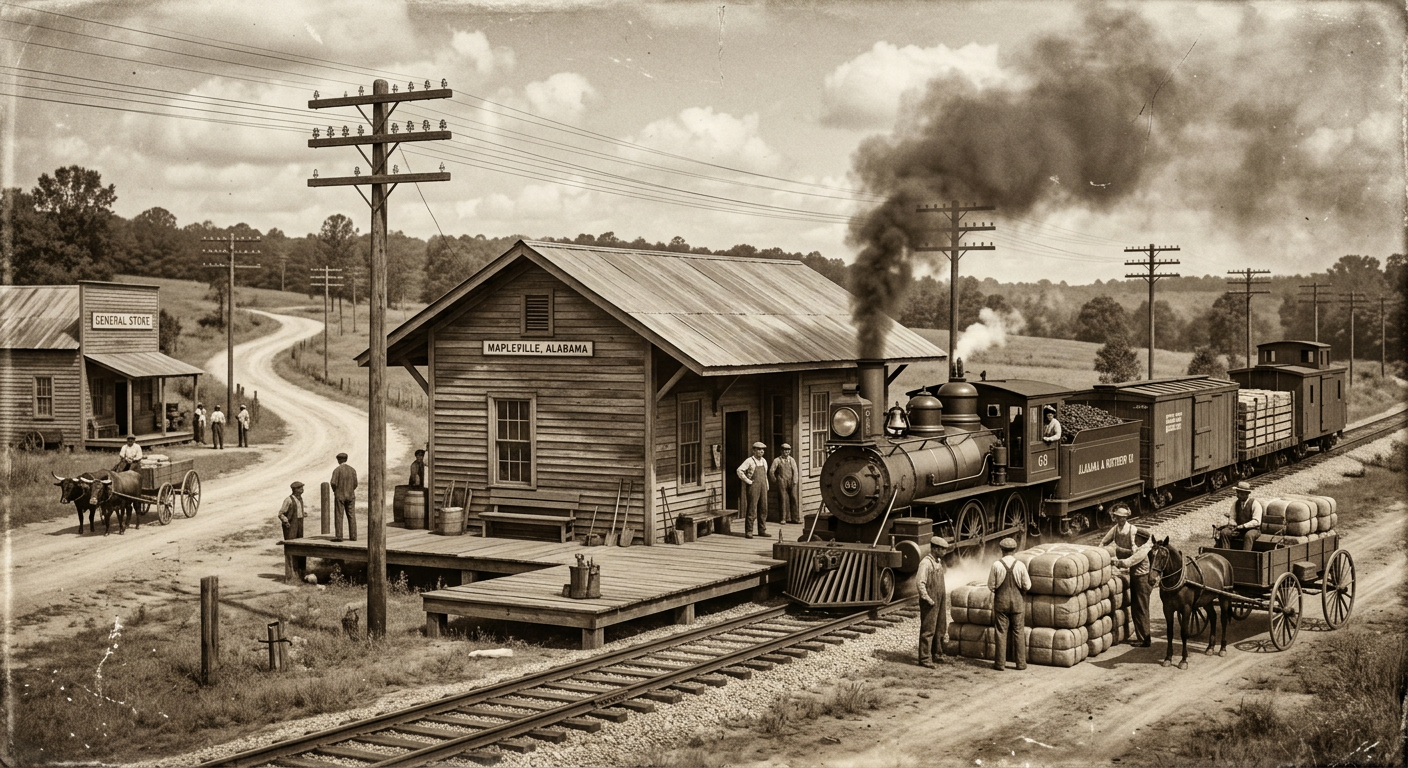
Through much of the twentieth century, the depot was the center of town life. Farmers brought cotton and timber to be shipped; families met the train to collect mail and packages; and young people boarded it to seek work and education in Birmingham, Mobile, Chicago, Detroit, and beyond. Like many small towns of the region, Emelle's population was shaped by the Great Migration, as thousands of Black families left the rural South for northern and western cities in search of opportunity and freedom from Jim Crow.
Emma and Ella: How Emelle Got Its Name
According to local tradition, the town's name honors two young women — Emma and Ella — said to be the daughters of Joseph Dial, a railroad official associated with the line through the area. Combining “Em” from Emma and “elle” from Ella produced the distinctive name “Emelle,” unlike any other town in America.
Historians have noted that some details of the story are difficult to reconcile with surviving records, and the exact origins of the name remain a matter of local lore. Whatever its precise source, the name has been a point of pride for generations of residents.
Life in the Twentieth Century
For much of the twentieth century, life in Emelle revolved around farming, timber, the railroad, church, and family. Cotton remained important, but over time many Black Belt farms shifted toward cattle, hay, and timber as mechanization and the boll weevil transformed Southern agriculture. Small country stores served as gathering places, and churches served not only as houses of worship but as schools, meeting halls, and centers of community life.
These years also brought hardship and injustice. Segregation laws enforced separate and unequal schools, facilities, and opportunities. Black residents were largely excluded from voting. Racial violence, including a lynching in the Emelle area in 1930, left deep scars on the community and is remembered today as part of the painful history that the nation is still working to confront honestly.
The Civil Rights Era
During the 1950s and 1960s, the Civil Rights Movement swept through the Alabama Black Belt. Nearby Selma, Marion, and Greene County became nationally known for voting rights campaigns, and the effects were felt throughout west Alabama. The Voting Rights Act of 1965 opened the ballot box to Black citizens of Sumter County, and in the years that followed residents of the region began electing leaders who reflected the communities they served. The right to vote — won at tremendous cost — would prove essential to Emelle's later decision to govern itself.
The Landfill and the Fight for Environmental Justice
In 1977 and 1978, a hazardous waste disposal facility opened just outside Emelle. The site was chosen in part because of the geology of the Black Belt: the thick Selma Chalk beneath the soil was considered a natural barrier. The facility became one of the largest commercial hazardous waste landfills in the United States, receiving waste from across the country.
The arrival of the landfill in a small, largely Black, rural community sparked concern among residents about health, safety, and fairness. Local citizens organized, held meetings, testified at hearings, and joined with civil rights and environmental advocates to call attention to their situation. Emelle became one of the communities most often cited in the early environmental justice movement, which examined why polluting facilities were so frequently located in poor communities and communities of color. The voices of Emelle residents helped shape national conversations and studies on environmental justice in the decades that followed.
Incorporation in 1981
In 1981, residents took a decisive step: they voted to incorporate Emelle as a town. Incorporation gave the community its own elected government, the authority to adopt local ordinances, and a stronger voice before state and federal agencies. James Daily was elected as the town's first mayor. Incorporation was an act of self-determination — a statement that the people of Emelle intended to have a say in their own future.
Emelle Before the U.S. Supreme Court
The landfill near Emelle placed the town at the center of a landmark case in American constitutional law. In the late 1980s and early 1990s, the State of Alabama imposed an additional fee on hazardous waste brought into the state from elsewhere for disposal. The facility's operator challenged the fee, and in 1992 the United States Supreme Court decided Chemical Waste Management, Inc. v. Hunt, ruling that the discriminatory fee on out-of-state waste violated the Commerce Clause of the U.S. Constitution. The case is still studied by law students across the country, and it brought national attention to the small town of Emelle.
A Home of Great Artists
Emelle is the birthplace of Thornton Dial, born in 1928, who grew up in the area before moving to Bessemer. Largely self-taught, Dial became one of the most celebrated American artists of his generation. His powerful paintings and assemblages — made from found materials such as rope, tin, carpet, and wood — addressed history, race, labor, and the struggles and resilience of ordinary people. His work is held in major museums, including the Metropolitan Museum of Art in New York. Members of his family, including his son Thornton Dial Jr. and relatives such as Arthur Dial, also became recognized artists. See Notable People for more.
Emelle Today
Today Emelle remains a small, close-knit community in southwestern Sumter County, a few miles from the Mississippi state line. Like much of the rural Black Belt, the town has faced population decline as young people have moved away for work and education. Yet the community endures, sustained by its churches, families, and long memory.
Residents have weathered hard times together — including severe storms, such as the tornado that struck the area in January 2023. Each time, neighbors have come together to clean up, rebuild, and look after one another. The Town of Emelle continues to serve its residents through its elected Mayor and Council, its police department, and the shared determination that has defined this community for generations.
For a year-by-year view, see the Historical Timeline.
Sources & Further Reading
- Encyclopedia of Alabama — Sumter County; Black Belt Region; Thornton Dial
- Alabama Department of Archives and History
- U.S. Census Bureau, decennial census of population
- Chemical Waste Management, Inc. v. Hunt, 504 U.S. 334 (1992)
- Robert D. Bullard, Dumping in Dixie: Race, Class, and Environmental Quality
Residents who have historical photographs, documents, or family stories about Emelle are invited to share them with City Hall so that they may be preserved for future generations.